Stop sampling.
Start monitoring.
Gravimetric sampling tells you what your workers breathed last quarter. Arpuro tells you what they're breathing right now — at every furnace, every shift. Catch exposure events as they happen. Not three weeks later in a lab report.
Floor plan · live readings · time-series
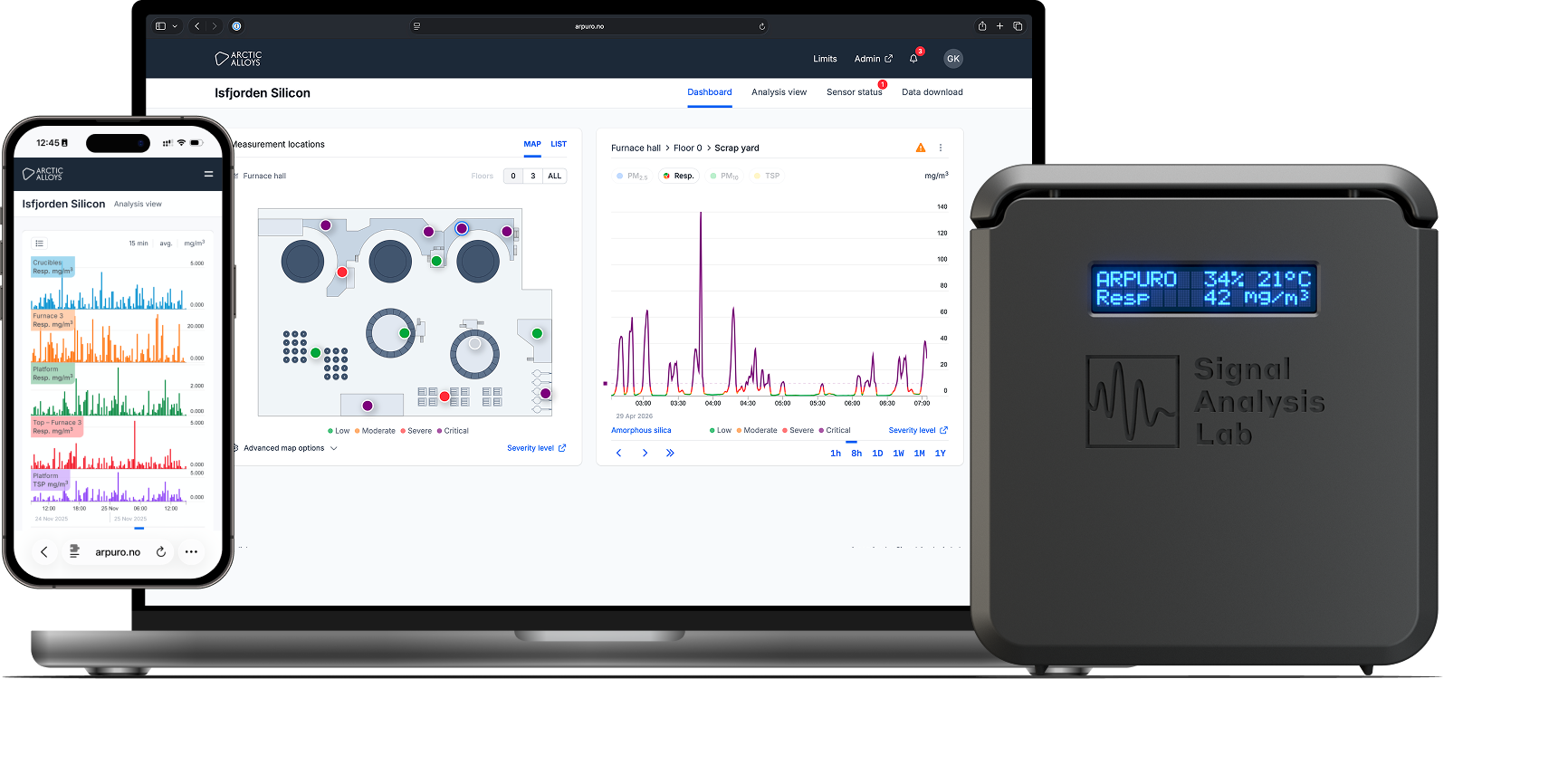
Operational by lunch.
Not by quarter-end.
No IT integration. No cabling. No multi-day commissioning. Three steps, the longest of which is the courier.
A sensor lands at your site.
A 14×15 cm enclosure, factory-calibrated and ready to deploy. Optional field calibration is available — and when we recalibrate, every reading back to installation gets the new constants too, so historical data stays accurate.
Two screws and a power lead.
Mount under 20 minutes. Power on. The sensor connects itself to our cloud over 4G — no firewall config, no IT ticket, no Wi-Fi password.
Live data on every phone.
HSE gets push alerts when limits are crossed. Workers see exposure before entering. Automated reports that complement your accredited gravimetric measurement program.
Designed in collaboration with industry. For industry.
Repairable. Serviceable. Sustainable by design.
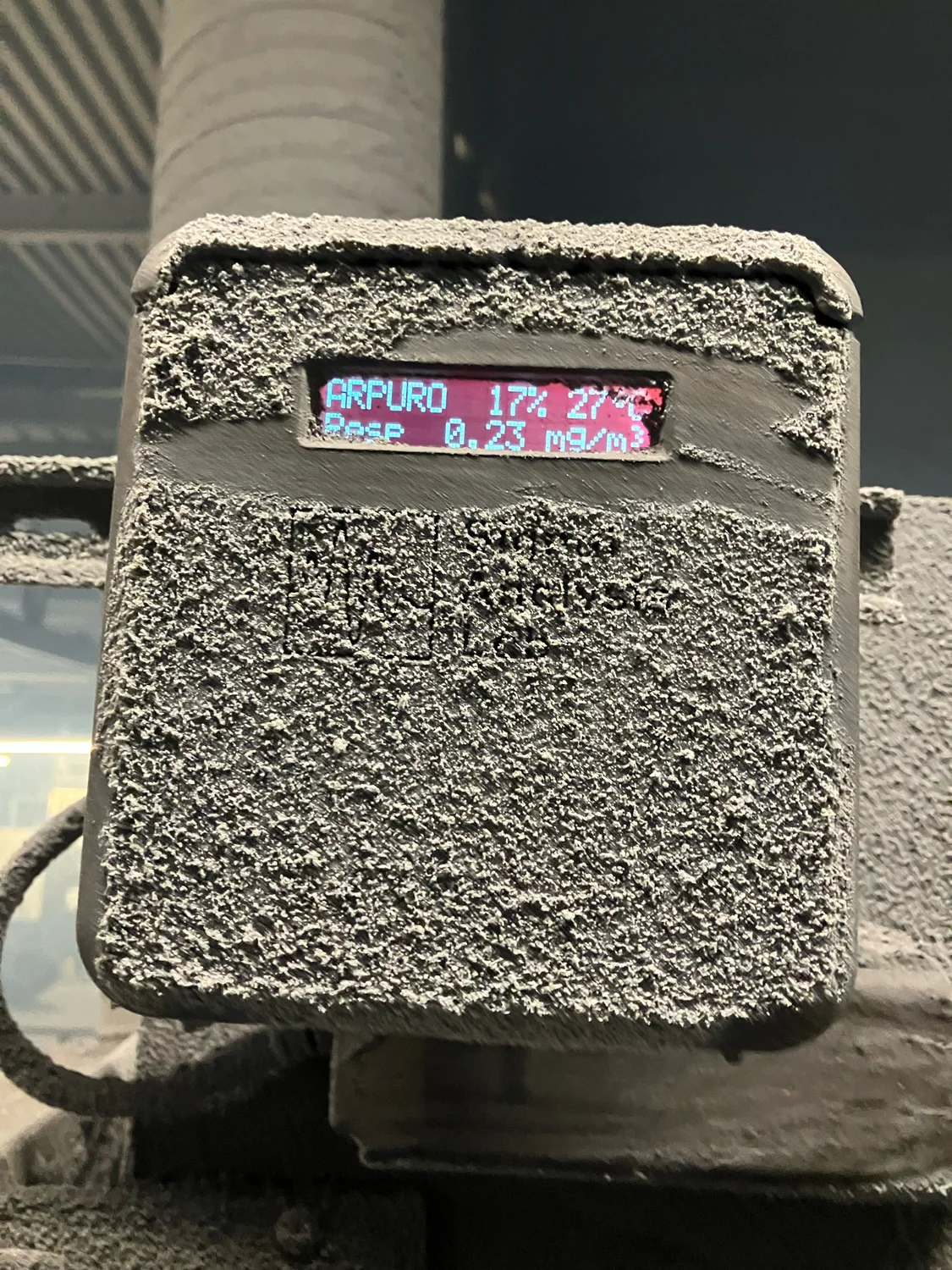
Optimized inlet. Cleans itself. Keeps sampling.
Built for industry.
Office sensors top out around 10 mg/m³ and rely on manual cleaning. Industrial dust needs headroom up to 1,000 mg/m³ and optics that stay clean on their own.
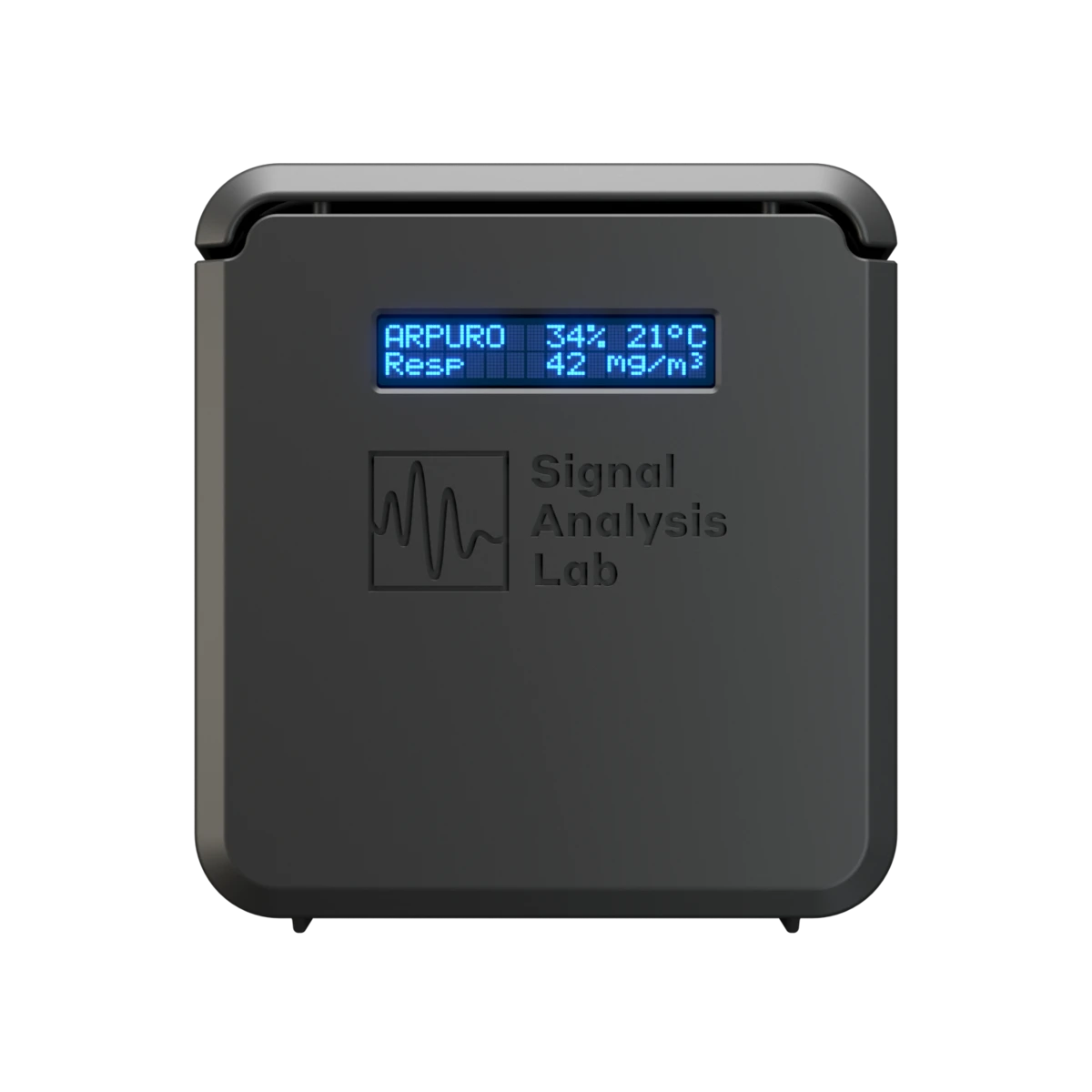
We calibrate the location, not just the sensor.
Most dust monitors are factory-calibrated against ISO 12103-1 A2 — better known as Arizona road dust. The moment your dust isn't Arizona road dust, the readings drift. So we do it differently. Then a customer checked our work.
The method
- 01 — Calibrated to your actual dust
- A reference sensor measures the real dust at each location and stores a correction coefficient for that spot. Silica fume isn't road dust. Cement isn't slag. Each location learns its own correction.
- 02 — Swap sensors freely
- The calibration belongs to the location, not the hardware. A replacement sensor inherits the constants on day one — no re-commissioning, no per-device offsets, no field engineer.
- 03 — Drift-corrected, retroactively
- When we recalibrate, every reading back to installation gets the new constants too. Historical data stays accurate.
Independently validated
Linearity across 0.4–27 mg/m³. Eight reference samples at three locations. Six months after install, no maintenance.
- Uncertainty
- ±14%
- Drift in 6 months
- None
- vs. accredited lab
- p > 0.05
Patent pending — PCT/EP2025/052264 →
Independent customer validation · Lab analysis by Nemko Norlab (accredited lab, Test 032 →)
From dust event
to auditor-ready report.
Real-time data integration, plain-language access, and open data export. Connect via API, download from the portal, or just ask in your own words.
Site-aware by default
Each location carries its own calibration coefficients and OEL limits. Move a sensor between floors and Arpuro recalibrates automatically — no engineer visit, no spreadsheet to update.
Plain-language access
Ask "show me the worst locations at Holla last month" — get a ranked table, charts, and a written summary. No coding, no dashboards to configure. The MCP server is in production today.
Open data, open reports
Word and Excel reports modelled on the format an ISO 17025-accredited lab would issue, with values mapped to your local OEL framework. Or pull raw measurements via REST API. Your data is yours — fully exportable, no lock-in.
Where the heaviest dust is, Arpuro is.
From Norwegian ferro-alloy plants to silicon furnaces in Iceland and quartzite mines in Spain — deployed where the dust is hardest to measure.
Continuous measurement of dust concentration at our plants is a major leap forward. I've wanted this for many years — until now, we lacked the solution.

- 41%of Norwegian ferro-alloy production(by tonnage)
- 15%of European silicon-alloy smelting industry
- ~1%of global ferro-alloy production
- 20 sites
- 13 customers
- 3 countries
- World's largest quartzite mine
- World's #1 & #2 silicon furnaces
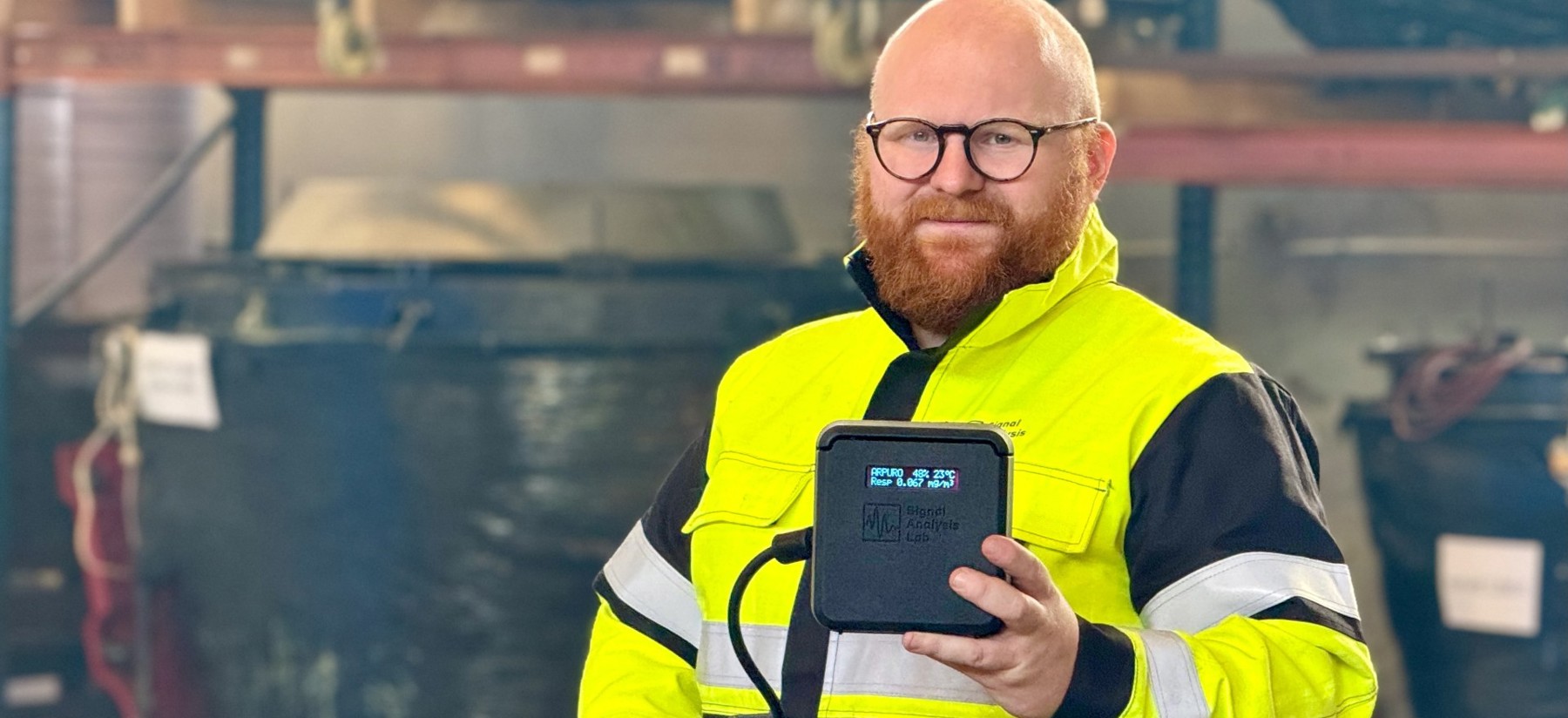
From the team behind Signal Analysis Lab.
Arpuro Labs is 100% employee-owned by the engineers behind Signal Analysis Lab — focused entirely on industrial dust monitoring.
About usMeasurement-as-a-Service.
Hardware, hosting, replacements, support and platform — bundled. OPEX, predictable, scales with your site count. Start with one sensor, expand when the data makes the case.
- Hardware included — no upfront CAPEX
- Sensor replacements per estimated MTBF*
- Unlimited platform users · API access
- Setup consultation — we tell you where to mount it
* Terms apply
Need outright purchase or non-standard calibration? Talk to us.
Heavy industry. Harsh environments.
Metallurgy
Foundry fumes, slag handling, electrode dust around the furnace floor.
Mining & tunnels
Quartz dust in open-pit and underground operations, drill-and-blast cycles.
Cement
Kiln dust, raw material crushing, clinker handling and silo loading.
Energy
Coal handling, biomass conveyors, fly-ash and electrostatic precipitator zones.
Construction
Demolition silica, earthworks dust, concrete cutting and tunnelling fines.
Food & grains
Flour, sugar, grain silo dust — combustible atmospheres requiring active monitoring.
What others say about us.
Notes from the field.
Calibration research, case studies, and field notes from the engineers building the product. Written for the people running the plants.
Read the blog Find your worst
dust hotspot — 30-day trial.
Pick one production line. We'll send a sensor and set up a 30-day monitored trial. The data from the trial becomes the business case for full coverage.
- Reply within one business day
- Reply in 11 languages — pick yours above
- Your data stays with us — never sold or shared